Why Are Chimpanzees So Fascinated by Crystals?
A crystallographer in Spain wondered what would happen if chimpanzees were shown crystals of various shapes and sizes. The results were surprising, and Juan Manuel García-Ruiz of the Donostia International Physics Center believes the findings reveal something about our own ancestry.
Juan Manuel García-Ruiz
García-Ruiz and his team placed crystals with chimps who are living quasi-freely in a sanctuary (Rainfer Fundación Chimpatía near Madrid). First they placed a one-foot-tall multifaceted quartz crystal on a pedestal in the chimps’ yard; nearby they put a regular sandstone rock of similar dimensions on the same base.
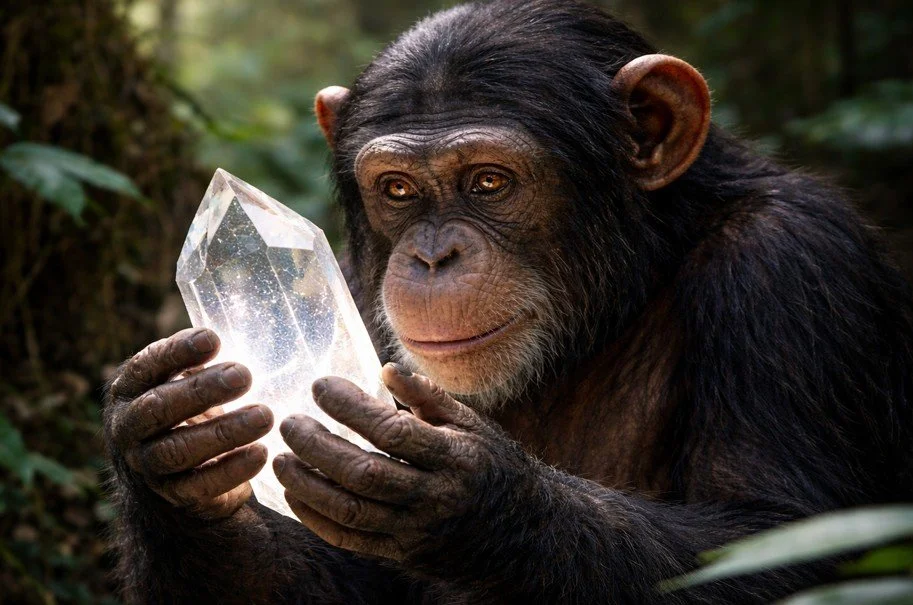
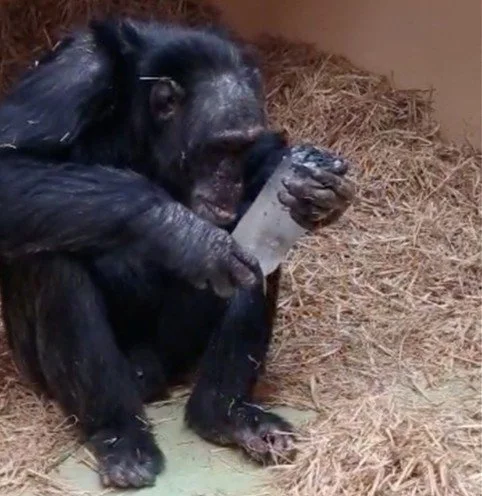
As the New York Times puts it, “the chimps went crystal cuckoo.” In one yard, the chimps repeatedly approached the monolith until the alpha female, Manuela, grabbed it from the pedestal. The troop ignored the sandstone rock, but the crystal never left their sight. A 50-year-old male named Yvan lugged it around while climbing and eating, “passing it between his hands and feet with great panache.”
Then the chimps were given a pile of both quartz crystals and regular pebbles. The chimps immediately sorted out the crystals. Yvan held a quartz piece up close to his eye, examining it like a gems merchant. Some chimps carried the crystals around in their mouths. Others slept with them.
What’s it all mean? It could be that they are simply fascinated by the precise shapes and transparency of crystals, but García-Ruiz thinks the animals are experiencing “something beyond curiosity.” He wants further experiments to include other apes in the real wild, especially gorillas and bonobos.
Humans (and their non-human ancestors) have been fascinated by crystals for at least 780,000 years. Crystals of varying types have been found in Homo erectus living sites. They were not tools or ornaments, but proto-humans must have been fascinated by them, just as some are today.
The crystallographer has some lofty thoughts about humans’ interest in crystals as well. He speculates that crystals, as “the only Euclidean object in nature,” may have prodded humans to invent geometry, which could have been the trigger that unlocked abstract thought, separating us from our great-ape cousins.
García-Ruiz and colleague’s findings are published in the journal Frontiers in Psychology.
Photo credit: ChatGPT