


Should Scientists Try to Save the Northern White Rhino?
Last week scientists in Berlin announced they had successfully transferred a northern white rhinoceros embryo into a surrogate mom, the first successful use of a method that they say could save the nearly extinct rhino subspecies.
It was a Pyrrhic victory of sorts, since the surrogate female did not survive a bacterial infection in November. In fact the science team hadn’t even realized she was pregnant until after the fact, as the embryo was only discovered during the post-mortem exam.
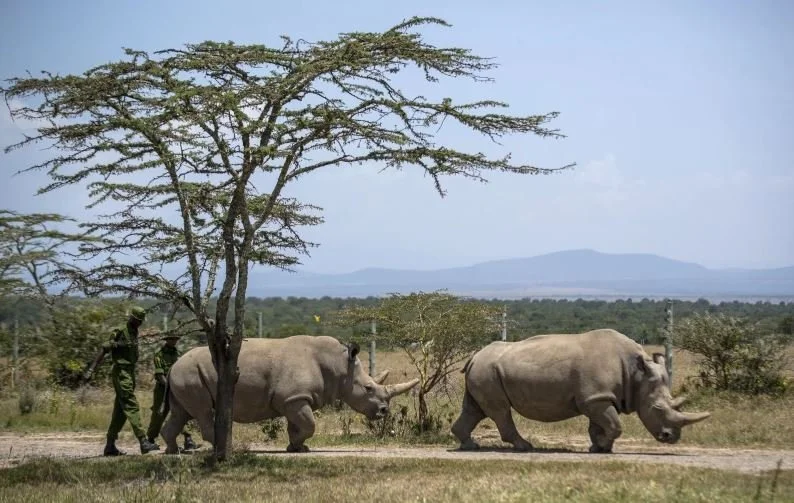
Still, the proof-of-concept procedure could be the last hope for the critically endangered subspecies, which is truly on its last legs. There are only two female northern white rhinos alive on the planet, but zero males, with the last of them dying in 2018. The southern white rhino population is a much healthier 20,000 or so.
The surviving northern white females, Najin, a 34-year-old, and her 23-year-old offspring, Fatu, live in the Ol Pejeta Conservancy in Kenya where they enjoy a 700-acre enclosure and 24-hour armed security guards.
The plan: harvest the eggs of one of the northern females, zap one with sperm harvested from one the last male rhinos of the subspecies (now dead, but his frozen seed is still viable), and transfer the resultant embryo to a healthy surrogate mother – namely a southern white rhino.
Some conservation groups think it’s too late to save the northern white rhino, whose habitat – in Chad, Sudan, Uganda, Congo and Central African Republic – has been ravaged by human conflict.
“News of the first successful embryo transfer in a rhino is an exciting step, however it sadly comes too late to recreate a viable population of northern white rhinos,” Jo Shaw, CEO of Save the Rhino International, tells the Associated Press. “Our best hope remains to work with the range of partners involved to give rhinos the space and security they need to thrive naturally.”
The scientists who instigated the miracle pregnancy are more sanguine. “We achieved together something which was not believed to be possible,” Thomas Hildebrandt, head of the reproduction management department at the Leibniz Institute for Zoo and Wildlife Research, said at a press conference at Berlin's Tierpark zoo. “That is really a milestone to allow us to produce northern white rhino calves in the next two, two and a half years.”
It sounds like science is going to move forward, whether or not saving the northern white rhino is a realistic goal. Fine, so long as we don’t neglect the less sexy solutions to species loss, namely habitat preservation and anti-poaching enforcement.
Ben Curtis / AP Photo
Photo credit: Ol Pejeta Conservancy via Facebook


